15 Years of WannaFlex – “The real growth was not only in the company, but in me.”
“If I’m very honest, 15 years ago something didn’t necessarily have to change in recruitment-but mostly in me,” Sjoerd explains. “My background was totally different. I came from the army, was a truck driver and then worked as an intermediary in logistics. I was actually hardly knowledgeable about recruitment.”
What he did take with him later turned out to become the core of WannaFlex: the importance of specialism. “At Worktrans, I saw how important it is not just to deliver someone quickly, but the right person. If you really understand what a job entails, you are seen on both sides as someone with added value. That’s where trust begins.”
That conviction formed the basis of WannaFlex. First as a specialist in software testing, later as a partner within the entire Software Development Life Cycle (SDLC). “We started with one clear focus, and that made us strong. But at some point we were challenged to look broader. A customer needed more than just testers-he was looking for support across the entire SDLC. That was a tipping point.”
That broadening was not an easy choice. “Internally there was resistance, and I understood that. Our specialty was deep. But I saw it as an opportunity. We took that step and proved that we could also deliver the same quality within roles such as developers, product owners and data engineers. That really accelerated our growth between 2020 and 2025.”
But growing did not automatically mean doing everything.
“In 2026, we made another important choice. Not broader-but deeper. From market demand, but also from a clear conviction: where can we continue to guarantee our quality?
More is not always better. That’s why we focus on interim and project secondment, going deeper into our areas of expertise. Roles that don’t fit there, we deliberately let them pass us by.
Because in the end, it’s not about doing everything-but doing the right things exceptionally well. And that suits WannaFlex.”
The road to this was anything but straight. “The moments no one sees are perhaps the most important. Doubt, low energy, choices that don’t work out. I learned that how I’m in the game-my discipline, my mindset-directly affects the business. If that’s not right, you see it in the results.”
One of the biggest lessons came when WannaFlex almost toppled over after growing too fast. “We hired a director before the foundation was really in place. Costs were rising, but results were lagging. That taught me that growth requires foundation: a clear strategy, processes and execution. Only then does it become scalable.”
Today, WannaFlex stands as a mature player within the IT market, with strong expertise within analysis, design, front-end, back-end and testing. “We have shown that we can really help IT managers. Not just by delivering quickly, but by understanding what they need and bringing the right interim specialists who make an immediate impact.”
According to Sjoerd, the difference between an agency and a true partner is in the way they work together. “A partner relationship is equal. You are critical of each other, you share insights and work together toward the best result. That requires trust, transparency and integrity. That is something we have always maintained.”
Yet his greatest pride is not in sales or growth. “It’s in personal development. Who I have become in this process. As Jim Rohn says, it’s not about the goal, it’s about who you become as you achieve it.”
Looking back on 15 years of WannaFlex, he smiles.
“We created something that matters. And maybe now for the first time I can really say: I’m proud of that.”
Equal pay, latest news.
What does “equal pay” mean for principals?
As of Jan. 1, 2026, something fundamental is changing in the world of flex work. The familiar hirer compensation will give way to a new principle: equal pay. And that has a direct impact on clients.
What exactly is changing?
Whereas previously the focus was on a limited number of compensation components (such as wages and benefits), soon it will be on the total benefits package.
That means that as a client you no longer just look at:
hourly wage
overtime bonuses
But to the full value of what a permanent employee gets, such as:
salary and pay scales
vacations and vacation pay
bonuses or profit distributions
pension plans
mobility and home office allowances
training budgets
The bottom line: 👉 A flex worker should be rewarded comparably in total value to a permanent colleague in a similar position.
From ‘equal pay’ to ‘equal total package’
The difference from the old arrangement is significant:
Through 2025: focus on some fixed wage components
From 2026: focus on the total value of all working conditions
In other words, from “equal pay for equal work” to “equal total package for similar work.”
What does this mean for you as a client?
This change makes the playing field fairer, but also more complex.
You must as an organization:
Have full insight into your own working conditions
Be able to translate these into a similar package for flex workers
be more aware of differences between permanent and flex
Why this legislation?
The new rules are there to:
Reduce differences between permanent and flex
prevent unfair competition
better protect flex workers
And this is probably just the beginning. Regulations around flexible work are expected to be further tightened in the coming years.
What can you do right now?
Smart clients are not waiting until 2026, but are preparing now:
map your working conditions
check where differences are
make sure your processes are set up accordingly
In short: flexibility remains important, but it becomes fairer and more transparent.
And that requires a new way of working together.
New ZZP Legislation in 2026
Dutch self-employed legislation continues to evolve. While the VBAR law was originally intended to clarify false self-employment, political attention now seems to be shifting toward the proposed Self-Employed Act (Zelfstandigenwet). This potential new zzp law, expected around 2026, aims to provide clearer upfront guidance on when someone can genuinely operate as an independent professional.
For IT freelancers and hiring companies, this matters. The IT sector relies heavily on flexible talent, interim specialists, and freelance expertise to stay innovative and agile.
Why a new ZZP law?
In recent years, uncertainty around false self-employment in the Netherlands has increased. Since tax authorities resumed stricter enforcement, some organizations have become more cautious about hiring freelancers — including in IT, where independent specialists are often essential.
The Self-Employed Act aims to reduce this uncertainty by assessing factors such as:
demonstrable entrepreneurship (e.g., multiple clients, business independence)
how the working relationship with the client is structured
sector-specific considerations where relevant
The goal is to reduce grey areas without limiting the flexibility the market depends on.
What does this mean for IT freelancers and clients?
For now, daily practice remains largely unchanged. If you work with:
✔ clear project-based agreements ✔ a professionally structured collaboration ✔ a market-conform hourly rate (often €36+ indicative)
the risk of discussions around false self-employment generally stays limited.
For IT hiring companies, this mainly means ensuring contracts, project scopes, and collaboration structures are set up properly. For IT freelancers, it means continuing to visibly operate as an independent professional.
Stay prepared — but don’t panic
The final shape of the 2026 ZZP legislation is not yet confirmed. Political decision-making is still ongoing and details may change. What is clear, however, is that transparency, solid agreements, and professional collaboration will only become more important.
Unsure whether your IT contracts or freelance setup are future-proof? WannaFlex is happy to think along with you — whether you’re an IT freelancer or hiring one.
‘Gooi een balletje op’ about the VBAR-law
A 15 minute video that will tell you all about the VBAR Act: What to Expect from the DBA’s Successor
In our recurring ‘vodcast’ series “Gooi een balletje op” (loosely translated as “Let’s bounce around an idea”), we explore complex topics that affect freelancers, clients, and the wider IT market.
This time, we’re diving into something that’s not yet law—but is already casting a long shadow: the VBAR Act.
What is it? What will it change? And what should you already be thinking about?
In this episode, Jochem talks to Jordi Rosendahl, labor law attorney at Lexence, about the upcoming VBAR Act—intended as the successor to the current DBA law.
Key takeaways from the episode:
What the VBAR Act is trying to solve
How it compares to the DBA
What risks freelancers and clients may face if the law passes
How the VBAR aims to reduce ambiguity in freelance contracts
What smart preparation looks like, even before the law becomes active
Why it matters: VBAR might still be just a proposal, but it reflects a clear shift in how the Dutch government views freelance work. Understanding it now can save you trouble later.
Save the Date: The WannaFlex Summer BBQ is Firing Up! 🔥
At WannaFlex, we believe IT recruitment should be personal. That’s why we’re inviting our community of IT professionals to join us for a summer evening of food, fun, and connection.
On June 19, from 18:00 to 21:00, our Amsterdam HQ will transform into the ultimate BBQ hangout. Expect sizzling grills, ice-cold drinks, good vibes, and great conversations. Whether you’re a developer we placed last month or a hiring manager we’ve been working with for years — we’d love to see you there.
PS. This isn’t just another networking event. It’s the WannaFlex way: casual, real, and just fun.
📍 Where: WannaFlex, Cruquiusweg 96N, Amsterdam 📅 When: Thursday, June 19, 18:00 – 21:00 🍔 What: BBQ, drinks & all your favorite tech & WF folks
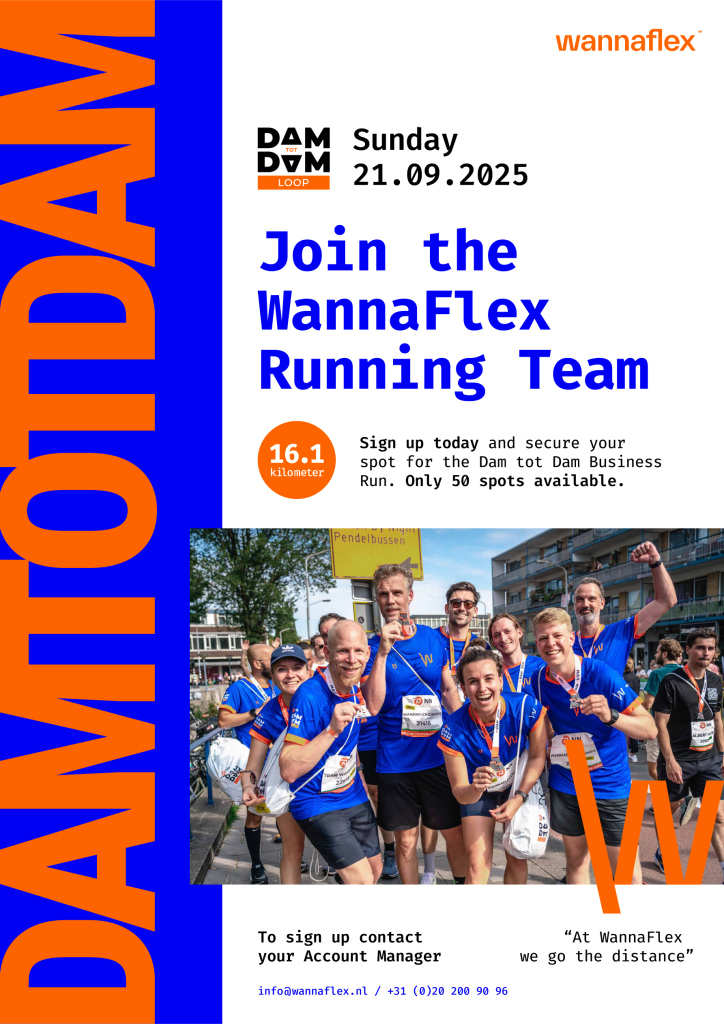
At WannaFlex, we love going the extra mile — for our clients, our IT specialists, and yes… even in our running shoes.
After last year’s amazing edition of the Dam tot Damloop, we’re doing it all over again! A 50-person dream team of clients, IT specialists, and WannaFlexers hit the road together — and honestly, we’re still not sure what was more fun: the run itself or the celebratory drinks we shared in Zaandam afterwards. 🍻
This year, we’re going bigger, bolder, and (hopefully) faster. Are you in?
Whether you’re running to beat your PR or just for the gezelligheid — we’d love to have you on our team.
👟 Sign up now to claim one of the 50 exclusive spots in the WannaFlex Running Team. You can contact your Account Manager or Account Executive directly – or send us an email at [email protected].
The reintroduction of the DBA Act is now three months behind us. And while the rules seem clear on paper, at WannaFlex we notice that in practice, many questions still arise. Especially in complex situations — for example, temporarily replacing a manager who not only leads a team but also reports to higher management and must adhere to organizational guidelines in daily operations. Two elements that, under the DBA Act, could potentially point toward a “permanent employment” structure.
The DBA Act is intended to prevent false self-employment, but in practice, it still regularly sparks discussion. In the case of an interim IT professional temporarily taking on a leadership role — is that even allowed? The short answer: yes, provided it is properly arranged.
When the nature of the assignment is clearly described, contractually secured, and correctly implemented in practice, the legal risks are minimal. It all comes down to awareness and clear agreements — right from the start. This way, you avoid misunderstandings and risks later on.
At WannaFlex, we guide clients through these kinds of questions every day and aim to take some of the uncertainty away. We also advise on alternative employment structures; whether freelance, deta-vast, or consultancy — we help you choose the right setup and ensure everything is legally compliant. A reassuring thought — for both client and IT professional.
Curious to learn more about the impact of the DBA Act? Check out our latest webinar on the topic ( Warning – it’s in Dutch 🙂